
Cold-Pressed Oils and the Entourage Effect: Why Botanical Synergy Matters
Some ingredients do more than fill a formula – they define what that formula can become.
For formulators, a botanical oil is far more than a source of fatty acids. When carefully produced, it becomes a complex natural system containing triglycerides, phytosterols, tocopherols, polyphenols and countless minor constituents that work together to influence skin feel, stability and overall product performance.
This interaction, often called the entourage effect or botanical synergy, highlights a fundamental truth about nature: the whole is often greater than the sum of its parts.
Nature Rarely Works in Isolation
Plants did not evolve to produce isolated compounds. Every seed, fruit and kernel developed an intricate balance of lipids, antioxidants and protective molecules to survive drought, heat, pests and environmental stress.
When these natural systems are preserved through careful processing, formulators inherit much more than a simple emollient. They gain an ingredient whose components interact in subtle ways that influence barrier support, oxidation stability, spreadability and sensory elegance.
Scientific literature increasingly supports the importance of this natural complexity. Rather than attributing performance to a single molecule, researchers are recognising the contribution of the complete botanical matrix.
For formulation scientists, this is less a marketing concept than a practical reality.
Why Cold-Pressing Matters
The value of botanical synergy depends entirely on what survives processing.
Cold-pressing avoids the high temperatures and aggressive refining methods that can diminish or remove naturally occurring micronutrients. When properly managed, it helps preserve the oil’s native composition, including many of the compounds responsible for its oxidative behaviour, sensory profile and biological compatibility.
The result is an ingredient that remains remarkably close to its natural state.
For modern cosmetic brands seeking multifunctional ingredients, this has obvious advantages. A carefully produced cold-pressed oil may simultaneously provide moisturisation, glide, barrier support and sensory refinement while contributing to a cleaner, more streamlined formulation.
Botanical Synergy Begins Long Before the Press
The quality of a botanical oil is determined long before extraction.
Harvest timing, weather conditions, seed maturity, drying methods, storage and transportation all influence the chemistry of the final oil. Poor handling cannot be corrected later, regardless of how sophisticated the processing equipment may be.
A season of excessive rainfall, for example, may alter free fatty acid or peroxide values, while improper storage can accelerate oxidation before pressing has even begun.
Botanical synergy cannot be manufactured after the fact. It must be protected throughout the entire supply chain.
This is why traceability and close relationships with producers matter as much as laboratory analysis.
The Chemistry Behind Performance

Every botanical oil tells its own chemical story.
Fatty acid composition remains the foundation of performance, but it is only one part of the picture. Oleic-rich oils often deliver exceptional glide and skin affinity, while linoleic-rich oils provide a lighter sensory profile. Naturally occurring sterols, tocopherols and other minor constituents further influence oxidative stability, skin feel and formulation behaviour.
Together, these components shape how an emulsion spreads, how a balm melts, how a serum absorbs and how consistently a finished product performs over time.
Formulators are therefore selecting far more than an INCI name.
They are choosing an entire botanical ecosystem.
Why Whole Oils Appeal to Modern Formulators
Today’s formulation teams are expected to achieve more with fewer ingredients.
Consumers increasingly favour shorter ingredient lists without compromising efficacy or sensory appeal. Cold-pressed botanical oils naturally align with this direction because they contribute multiple functional benefits simultaneously.
A well-characterised botanical oil may provide:
- Skin conditioning
- Barrier support
- Elegant sensory characteristics
- Carrier functionality for lipophilic actives
- Texture enhancement
- Product identity and authenticity
That versatility explains why cold-pressed oils continue to play such an important role across facial oils, creams, balms, cleansers, body care and hair care.
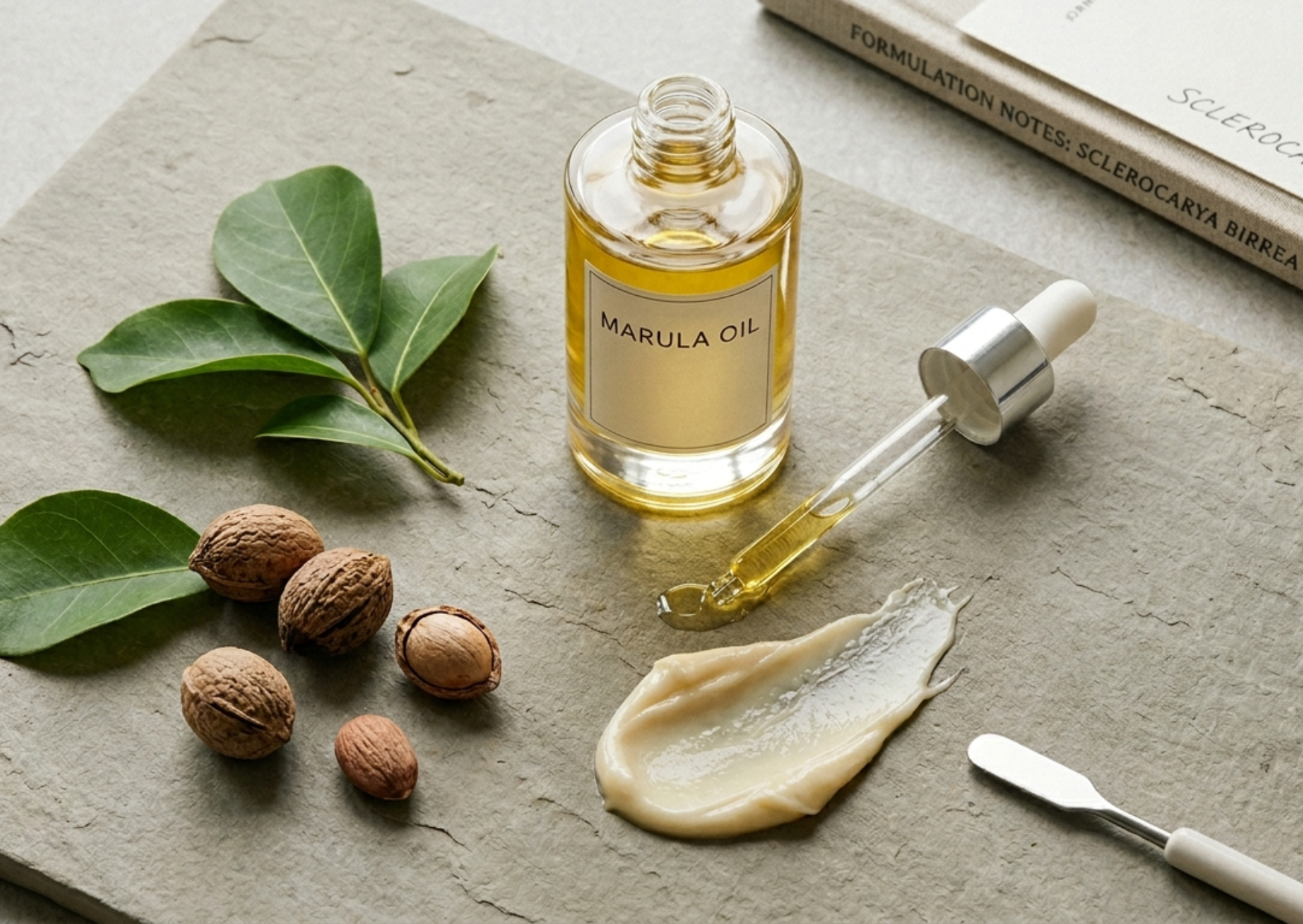
Marula Oil: A Good Example of Botanical Synergy
Marula oil illustrates this principle particularly well.
Clinical studies have demonstrated that Sclerocarya birrea seed oil is non-irritating and provides moisturising, hydrating, and occlusive properties. These complementary characteristics make marula oil attractive for formulations seeking both performance and simplicity.
Yet marula also demonstrates another important lesson.
Its quality depends not only on the species itself but also on responsible harvesting, careful drying, appropriate storage, and gentle extraction. Preserving the integrity of the botanical material allows the oil to retain the characteristics that formulators value most.
In many respects, exceptional oils are created as much by good stewardship as by good chemistry.
Transparency Builds Better Ingredients
Ingredient quality no longer stands alone.
Today’s cosmetic brands increasingly evaluate traceability, sustainability and responsible sourcing alongside technical performance.
Knowing where an oil originated, how it was harvested and how it was processed gives formulators greater confidence in consistency from batch to batch.
For suppliers, transparency has become an essential part of quality assurance.
A well-documented supply chain not only supports regulatory requirements but also strengthens consumer trust in finished products.
Conservation Is Good Formulation
Botanical ingredients cannot be separated from the landscapes that produce them.
Healthy ecosystems, responsible harvesting practices and fair partnerships with local communities all contribute to the long-term availability of exceptional botanical oils.
For African botanical species in particular, conservation is not simply an environmental responsibility. It is an investment in the future quality of ingredients.
Protecting biodiversity helps preserve the remarkable natural chemistry that makes these oils unique in the first place.
Responsible sourcing, therefore, becomes more than an ethical commitment—it becomes part of intelligent formulation.
Looking Beyond Individual Ingredients
Increasingly complex formulations will not necessarily define the future of skincare.
Instead, it may be driven by a deeper understanding of ingredients that already exist in nature.
Cold-pressed botanical oils remind us that outstanding performance often arises from natural complexity rather than isolated chemistry. Their fatty acids, antioxidants and minor constituents work together to create ingredients that are elegant, multifunctional and remarkably effective.
For formulators, selecting a botanical oil is no longer simply about choosing an emollient.
It is about selecting an ingredient whose chemistry, provenance, processing and traceability work together to deliver consistent performance.
Understanding that relationship is where better formulation begins.
At Afrika Botanicals, we believe every exceptional botanical oil carries the story of its landscape, its people and its careful stewardship. Preserving that story is not simply good sourcing—it is the foundation of better formulation.